The Jesup Wagon
history of Black Liberation & Busses part #2

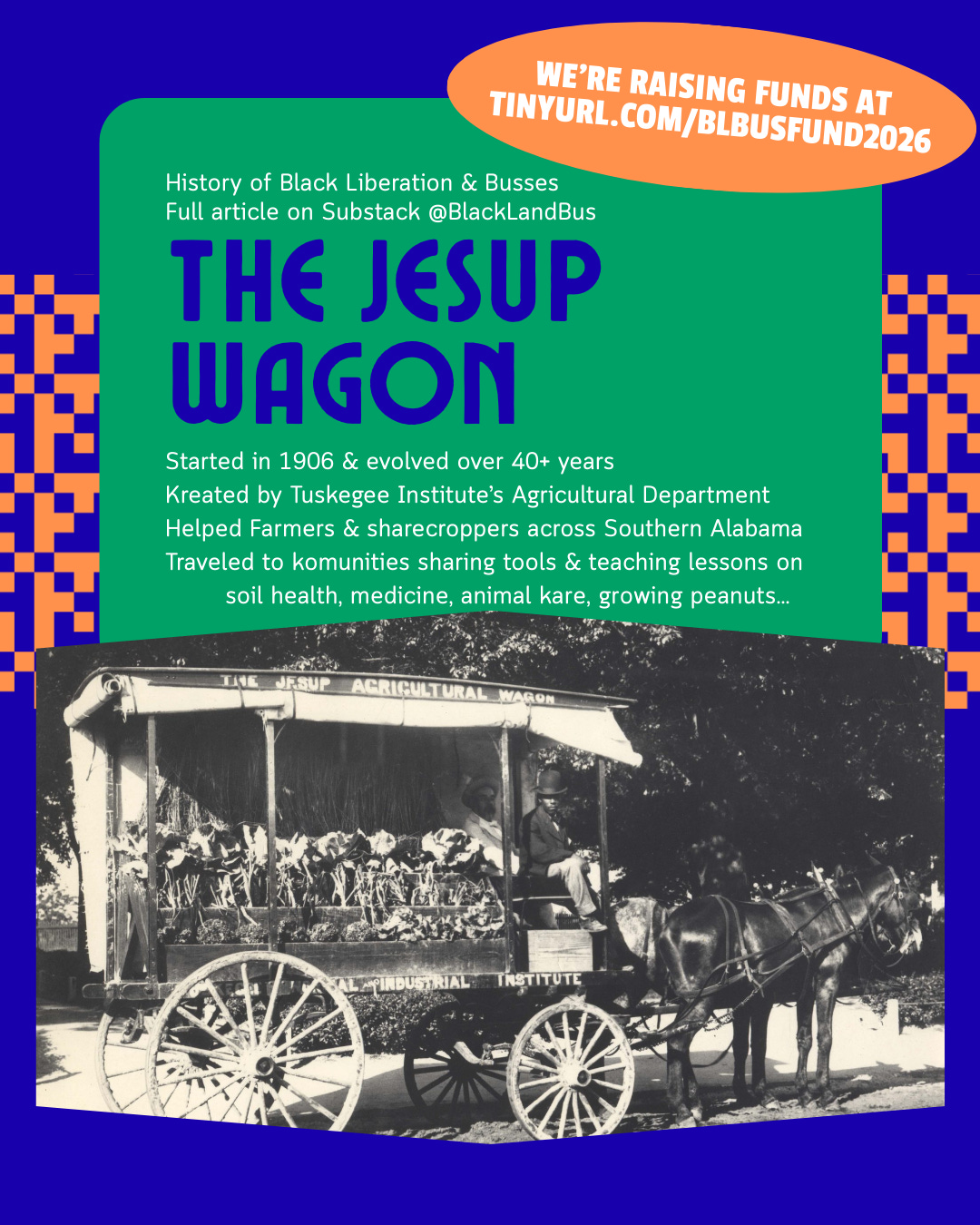
Today’s history lesson is about the Jesup Wagon. This absolute marvel of black history & its impakt on south Alabama is a klear precedent for the Black Land Bus & the achievements we will see in the coming decade.
George Washington Carver never knew his parents by nothing more than name & story. As a baby, he was bought by the Carvers, and later raised free.
In boyhood he was a small kurious thing. Raised on ample land in Missouri, he explored the woods and its flowers/stones/birds, often asking “God, why did you make this plant, and for what purpose did you make it?”. This direkt kontakt is how he kame to know the Lands he inhabited and is what inspired his passions for agrikulture, painting, and chemistry.
Around 8 years old, with no money, he ventured to the nearest town with a school, and began working to pay for classes. Odd jobs helped him pay his way to a highschool kompletion certificate & be accepted into a kollege in Iowa. Though upon arrival he was denied admission due to his race.
Stranded but kontinuing on as one does, George Washington Carver kept working, painting, and learning the Land he was then on. This led to him being able to enroll at Iowa State College in 1890. After teaching agrikulture there for a few years, he met Booker T. Washington during a speaking tour. Booker offered an invitation to be head of the Agrikultural Department as the up and koming Tuskegee Institute! Carver whole heartedly accepted this position & prepared himself to move to new Lands.
Booker T. Washington’s life is its whole own story (for which he wrote an autobiography: Up From Slavery), but know he was born enslaved aswell &, after freedom, worked his way through school. He attended Hampton Institute & in 1881 founded Tuskegee Institute with very little funding. Just Land bought from a $500 loan, a handful of students, and determination to get it out the mud.
The following passage is from The Life of George Washington Carver
“When Professor Carver entered upon his work at Tuskegee the agrikultural department was in its infancy. Funds had not been available to run it on a large basis. The old agricultural building was not adequate to accommodate various purposes for which it was used. It was just about as crude in architectural construction as one should have expected, during the early years of the school, when it was facing one struggle after another for the lack of funds.
This state of affairs, however, offered no difficulties for Carver to entertain, in fact, he considered disadvantages as stepping stones to accomplish his task. He simply got on the job and made himself busy.
One of the first things he set out doing was that of getting the laboratory in workable condition. Indeed, this was not a small job, because nearly all the necessary equipment was lacking. Here an opportunity came for him to practice a lesson which he learned when a boy, that is, the lesson of carving something out of nothing. Moreover, the lesson of translating opportunity into achievement, and how to triumph over complex problems.
As the apparatus in the laboratory were not sufficient, he sent his students out to the alleys to gather old bottles, broken china, and bits of rubber and wire, out of which he made apparatus. Soon afterwards, however, his temporary fixtures were displaced, gradually, with new equipment.
Dr. Carver began to roam over the fields and the woods, in the community, with the purpose of making a study of different kinds of soils, and various plants etc. He usually took along his botany case to gather specimens which he carried back to make a study of in the laboratory.
The people in the community didn’t know what to make of him when he was going through the fields and over the hills with his case, stopping here and there and gathering plants. All of this was strange to them. They thought, however, that he was a “root doctor.” Several people came to him for treatment and for medicine.”
Early on, the Agrikultural Department took stewardship over 19 akres for an Experiment Station. Here they tested kultivation techniques for different types of soils present in Alabama, and gave scientifik evidence for the methods George Washington Carver taught & developed.
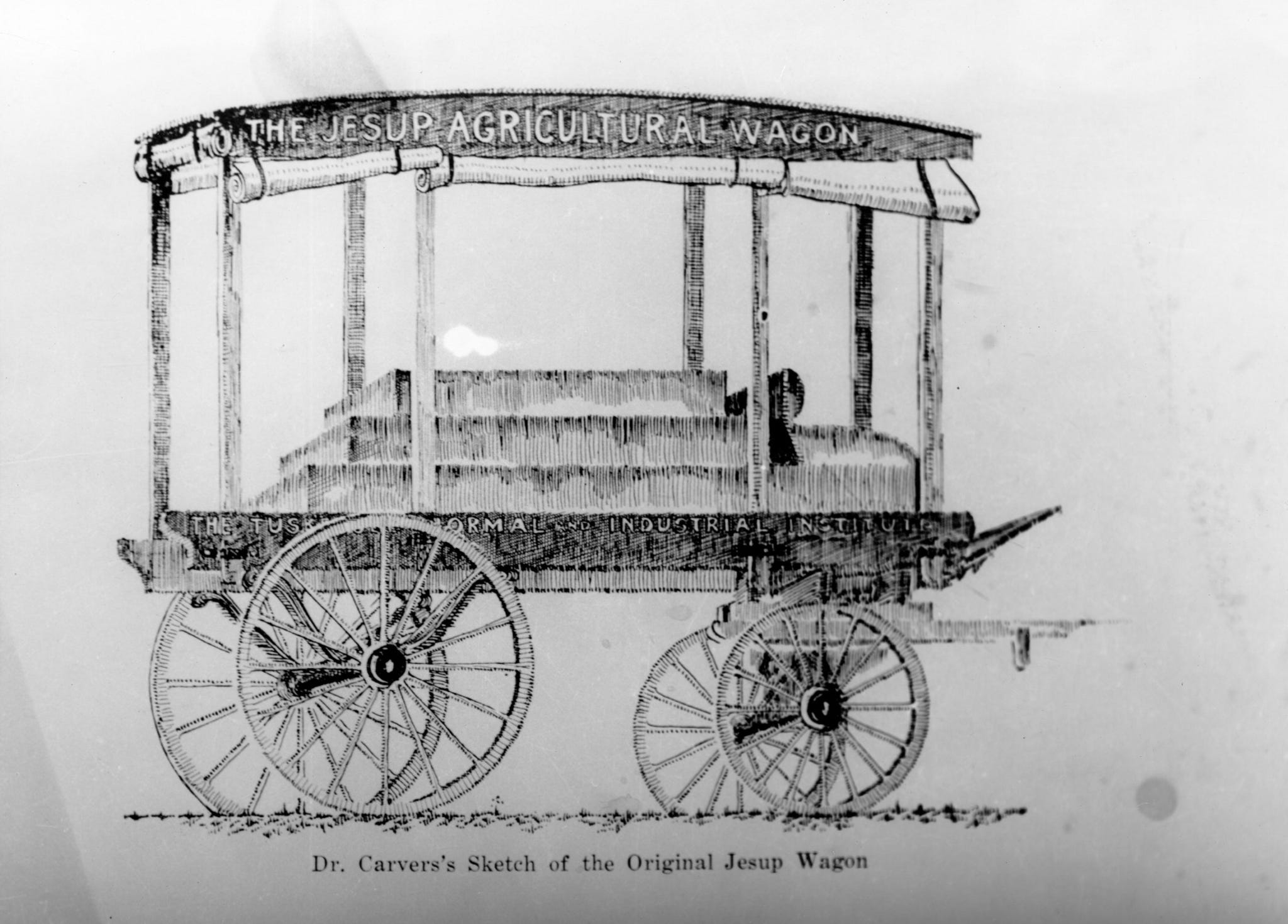
During this time Carver performed regular outreach to the farmers who kould not attend Tuskeggee Institute, but stood to benefit most from the teachings. This outreach ikluded katching rides karing what he kould & sharing techniques with farmers while kollekting samples from fields and forest. After 12 years of this, Booker requested he design a wagon that kould karry tools, perform demonstrations, and meet farmers in their komunities/on their Lands… and so it was birthed.
This passage is from Booker T Washington, Builder of Civilization
…“His plan was later carried out through the Jesup Wagon contributed by the late Morris K. Jesup of New York. This wagon was a peripatetic farmers’ school. It took a concentrated essence of Tuskegees’ agricultural department to the farmers who could not or would not come to Tuskegee.
The wagon was drawn by a well-bred and well-fed mule. A good breed of cow was tied behind. Several chickens of good breeds, well-developed ears of corn, stalks of cotton, bundles of oats and seeds, and garden products, which ought at the time to be growing in the locality, together with a proper plow, for deep plowing, were loaded upon the wagon. The driver would pull up before a farmhouse, deliver his message, and point out the strong points of his wagonload and would finally request a strip of ground for cultivation. This request granted he would harness the mule to the plow, break the ground deep, make his rows, plant his seeds, and move on to the next locality. With a carefully planned follow-up system he would return to each such plot for cultivation and harvest, and, most important of all, to demonstrate the truths he had sought to impress upon the people by word of mouth.”
The Jessup Wagon was SUPER versatile & people around were big fans of it. The lessons and tools carried improved with time and changed with the seasons. They spread pamphlets on everything for komposting & peanuts to klay dyes & kooperative marketing. Many organic garden products (made at the Tuskegee Institute) were on show too, boosting the lokal economy.
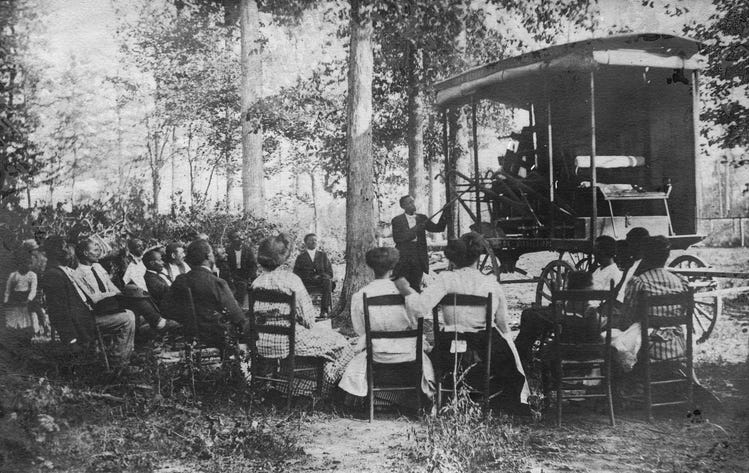
What’s really juicy to me, especially as it pertains to the work of the Black Land Bus, is this idea of kultivating strips of Land for demonstration purposes. Small fractions of Land where they would sow the best seeds & return regularly. These return visits turned into 2-3 day long classes with over 100 lokals, learning & sharing with one another. The classes were seasonal & made waves in the komunities of share kroppers and Land “owners”.
This is how I want the Black Land Bus to funktion. Growing slow and intentionally with komunities in our region. Partnering with black and indigenous farmers to build and leaving the komunities with more than just knowledge. We’ve been doing the work of spreading seeds, planting fruit trees, kreating gardens, and building up the BLBus over the past year, but I’m yearning for the day we put our hands in the soil to build up from the klay. Making burried greenhouses for farmers, and klay ovens, and eko village housing… yoooo imagine a playground made with the earth, just a space for komunity joy and the Land to be deeply integrated.
This old yet new architekture using Georgia Red Klay or Mississippi’s Lukfi Huta (pale grey klay in Chatah) fills my dreams & sketchbooks.
I see the story of George Washington Carver’s life & know following & sharing your passions will not go without reward. I read Booker T. Washington’s autobiography & know that building the institutions we need takes time & wide kollaboration to move us forward. This does not skare me, this only serves as inspiration for our komunities.
Back to the history lesson, The Jessup Waggon reached over 2,000 people in south Alabama over its first growing season. It grew to have 4 teachers onboard, inkluding manager Thomas Monroe Campbell & nurse Uva Mae & Alabama born George Bridgeforth.
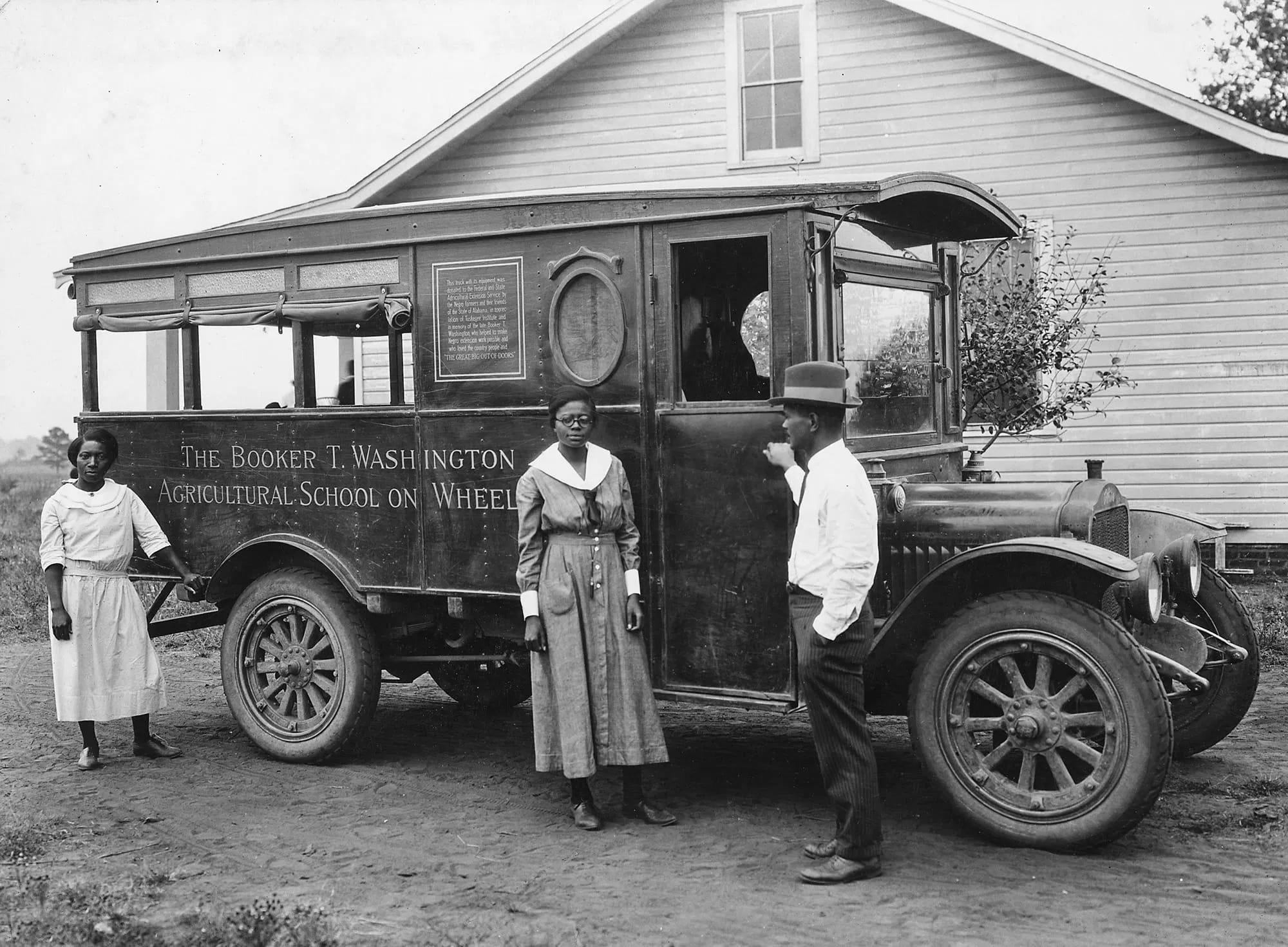
Soon the wagon got upgraded to a ford truck, & again to a larger vehicle with ability to vaccinate farm animals, projekt lessons, test milk, deploy playground equipment, and reach many many more farmers.
this passage is from The Life of George Washington Carver
“The Booker T. Washington School on Wheels” is composed of a group of teachers (four or five) and a very large truck which is well equipped with apparatus which the teachers use in demonstrating scientific farming; methods of improving the home, and most of all the teacher of domestic science and a trained nurse play a very important part on the program of this work.
This group of teachers travel throughout the rural districts of South and Southwest Alabama; going from one community to another with the purpose of assisting the Farmer. As a result of this work, farm life in these districts has become happier and more cheerful. It appears that the isolation which formerly existed has been greatly broken.
Dr. Carver has taken a very active part in this great movement of “The Booker T. Washington School On Wheels,” which is under the direction of the Tuskegee Institute. Various products which he has extracted from the peanut and the sweet potato, and also from other native products, have been exhibited on the tours through these districts. Hence, the farmers in that section of the State have been fortunate in getting first hand information as to the possibilities of the common products. There is no telling just how far reaching this movement may become.”
This work went on for 47 years and got over many bumps with wide ranging support, inkluding $5,000 being krowdfunded in 1923 for the vehicle seen below. It inspired the kreation of the Agricultural Extension Offices, which today is where many people go today to test their soils & find resources. The program was successful until the very end & only klosed bekause the extension offices grew to be desegregated, and reach every kounty in Alabama.
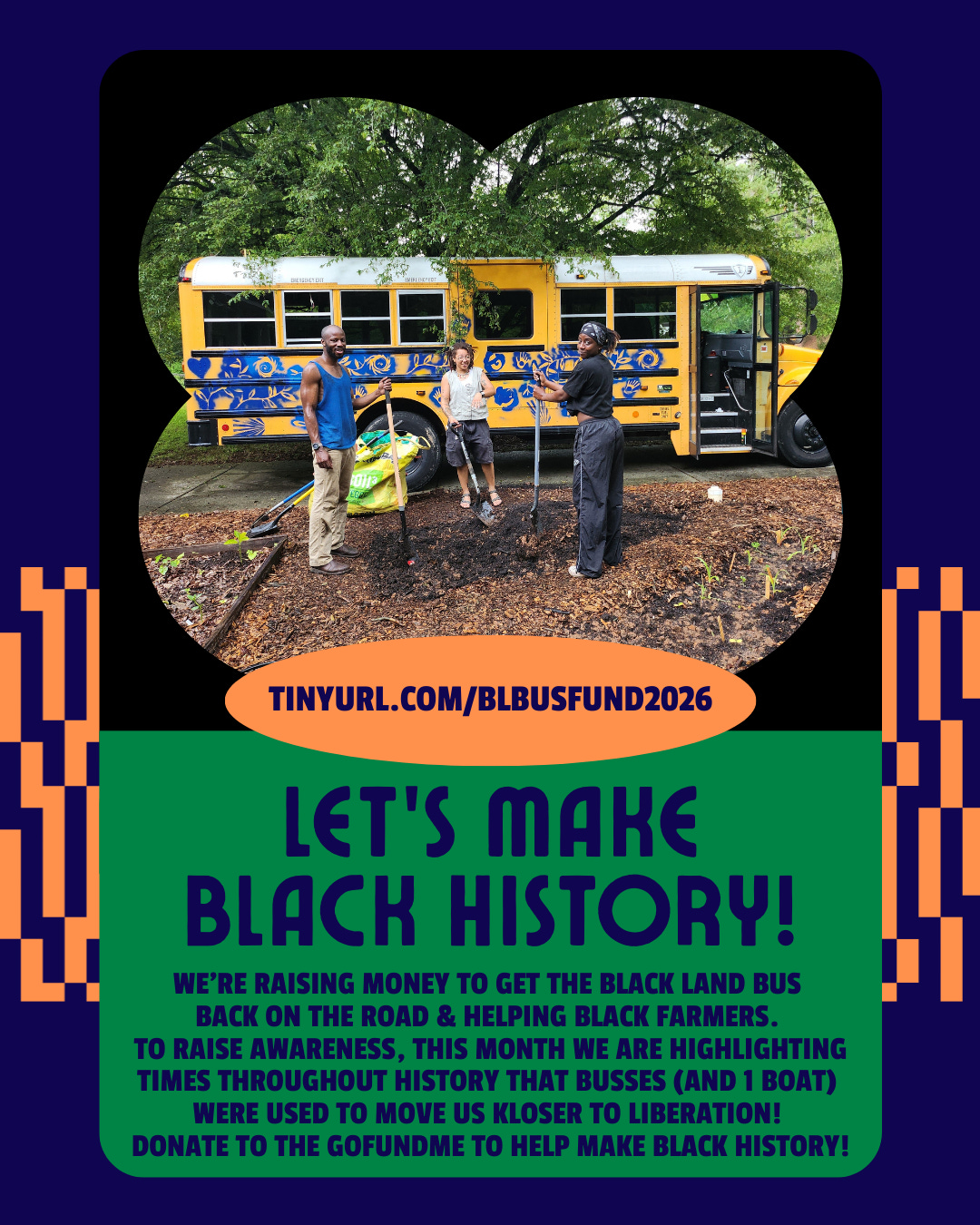
Today the Black Land Bus aims to expand this work in a time where klimate change & land theft threatens our food systems. Our goal is to be a mobile workshop space where komunities kan learn to build with the Land beneath our feet. This work is ongoing and being dokumented on Substack.
Kurrently we are raising funds for engine fixes, and almost half way to our goal of $20K. You kan support this work by donating to the GoFundMe & sharing widely.
Thank you for your time diving into the history of Black Liberation & Busses, see you next week!